
Prequalification is the check an operator runs before a contractor works on its sites: can this company do the work safely, and can it prove it?
Done well, it keeps unsafe contractors off site and saves good ones from answering the same questions again and again. Done badly, it is a pile of documents nobody reads until something goes wrong.
This checklist has two halves: what operators should ask for, and what vendors should have ready.
For operators: what to ask for
1. Company basics
- Registration documents (in Nigeria, the CAC certificate).
- Tax clearance and, in Nigeria, evidence of NSITF compliance.
- The services the company offers, and the named person responsible for health and safety.
- For Nigerian oil and gas work, registration on the industry’s joint qualification system, NOGIC JQS.
2. How they manage safety
- A health and safety policy signed by the company’s leadership.
- How they assess risk, investigate incidents and close the actions that follow.
- How they choose and supervise their own subcontractors.
3. Their safety record
- Hours worked and injury rates for the last three years (LTIFR or TRIR, whichever you use).
- Any fatalities, serious incidents or regulator notices, and what changed afterwards.
4. Insurance
- Certificates showing the cover, the limits and the expiry date.
- Your company named as additional insured, where your contracts require it.
5. People and equipment
- The certificates the crew needs for the work, such as confined space entry, rigging, or offshore survival training.
- For offshore and swamp work in Nigeria, a valid NUPRC Offshore Safety Permit for everyone going out.
- Inspection certificates for lifting gear and other equipment they bring.
Ask for what you will use. A cleaning contractor and a well services contractor don’t need the same questionnaire. Match the questions to the risk of the work.
Set an expiry date. Insurance, certificates and safety records go out of date. A prequalification approved three years ago tells you very little today.
For vendors: what to have ready
Most operators ask for much the same things. Keep them in one place, and the next invitation takes an afternoon instead of a fortnight.
- One folder with your registration documents, tax clearance, NSITF compliance, HSE policy and insurance certificates.
- Three years of numbers: hours worked, injuries and incidents, with what you changed after each serious one.
- A crew list with each person’s certificates and their expiry dates.
- Equipment certificates for anything you bring to site.
- A list of expiry dates, checked monthly, so nothing lapses in the middle of a job.
Be honest about incidents. An operator reading a perfect record will ask how you got it. A clear account of what happened and what you changed is worth more.
Declared versus demonstrated
A questionnaire tells you what a contractor says. Their record on your sites tells you what they do: whether they work within their permits, pass the checks and close their actions on time.
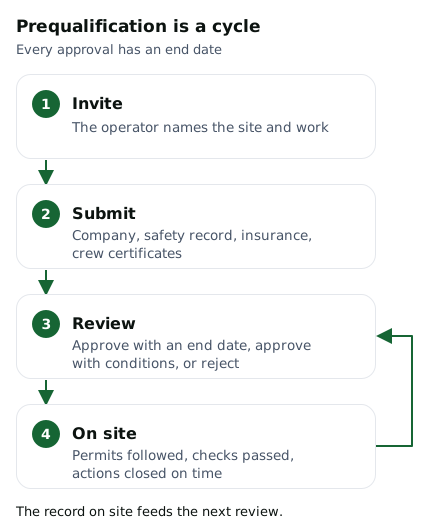
The best prequalification weighs both. A contractor that answered every question well but keeps failing checks on site is telling you something.
Where Validuty fits
For operators:
- Invite by email. The invitation names the site and the work, and the vendor gets a checklist showing what you still need from them.
- Ask for what fits the work. Set what you require for each kind of work: insurance with limits and expiry dates, safety statistics, financial documents and your own questions.
- Approve with an end date. An approval carries an expiry and is flagged before it lapses. A conditional approval lists what is still outstanding, for the vendor to see.
- Check the details. Insurance rules can check a certificate’s endorsements, so one that names nobody as additional insured fails, with the reason shown.
- See how they actually work. Beside what the vendor declared, you see how they perform on your sites: permit compliance, checks passed, incidents and how quickly actions close.
- Decide what happens next. An unapproved vendor can be warned about, or blocked from new work.
For vendors:
- It costs you nothing to work on an operator’s sites.
- Fill it in once. Your company details and your crew’s certificates are kept once and shared with every operator you work for.
- See what they see. You see the same performance record the operator sees, so you know what to improve.
Operators: book a demo with us. Vendors: see how joining works.